Business architecture governance
- 8–12 weeks typical duration of the build
In most organisations the quality of business architecture depends on individuals: every author models their own way, the maps have no owner, and decisions end up bypassing the material. The price comes later: the models go stale, trust runs out, and the work restarts with every project.
Business architecture governance gives this practice a framework: modelling standards as a common language, an owner and an update rhythm for every artefact, a forum for knowledge sharing. Its essence, though, is the embedding: the quality gates attach to the demand and delivery processes already in place, so every change also passes through an architecture lens, and the business commitments recorded at the decision can be verified. After the build we can stay involved in the operation: that is what Business architecture as a service is for.
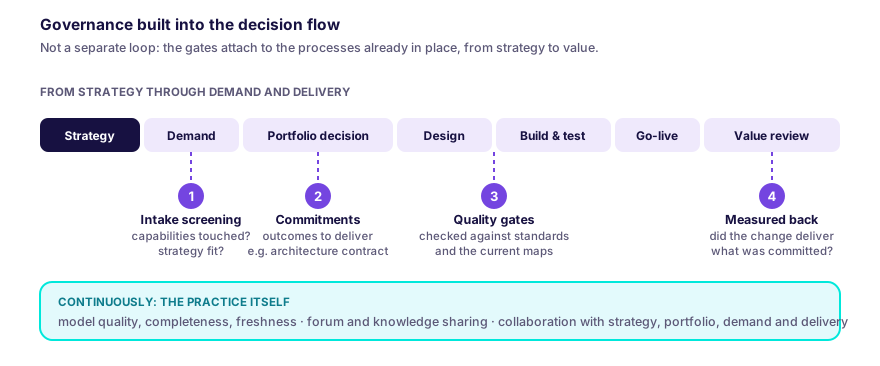
How governance builds into the decision flow
The quality gates are not a separate loop: they attach to the demand and delivery processes already in place, from the demands born out of the strategy to checking delivery against the business commitments recorded for the change.
When do you need us?

Every architect models differently
Every author uses a different notation and a different level of detail. The maps do not fit together and the knowledge is personal: when someone leaves, their model is orphaned.

Models go stale before they get used
Capability maps and value stream models get made, but they have no owner and no update rhythm. Six months later, no one trusts them.

Decisions bypass the architecture
Demands and projects run through the process without an architecture view ever being put in front of them: the material gets produced, but it is not part of the decision path.
Our process
Assessment
We look at how business architecture material is produced and used today, and where the link to demand management, the portfolio, and the implementations breaks down.
Standards and common language
We set modelling standards and templates for the capability map, value streams, and business models: naming conventions, levelling, and the links between the maps. Only as many rules as the work truly needs.
Building into the decision flow
We attach the quality gates to the demand and delivery processes already in place: architecture screening when a demand arrives, the business outcomes expected from the change recorded at the decision, and checks against the standards and the maps at the delivery gates. Every artefact gets an owner and an update rhythm.
Forum and metrics
We start the professional forum and the workshop routine, and introduce metrics: alongside checking delivery against the commitments recorded for each change, we measure the quality, completeness and freshness of the models, and the collaboration with strategy, portfolio, demand, and delivery.
Let's see what this would give you.
Book a free 30-minute consultationWhat you get
- An assessment of today's practice: where business architecture material is produced, and where its use breaks down
- Modelling standards as a common language: naming conventions, levelling, and templates for the capability map, value streams, and business models
- Quality gates built into the demand and delivery processes: every change passes through an architecture lens, not just the models
- Business commitments recorded for each change, with a routine for checking delivery against them
- A professional forum and workshop routine for knowledge sharing
- Metrics: delivery on the commitments, the quality, completeness and freshness of the models, and the collaboration with adjacent areas
What it gives you
- Model quality and use that no longer depend on individuals
- A common language for modelling, with maps that fit together
- Architecture as part of the decision path: every change passes through it, from demand to go-live
- Changes that can be verified: it becomes visible whether a change delivered what was committed at the decision
- Business architecture as an organisational capability, not the personal routine of a few people
Frequently asked questions
How is this different from EA governance?
EA governance spans the whole enterprise architecture: alongside the business layer, the application, data, and technology architecture, and in some cases security architecture, too. Business architecture governance zooms into the business layer of this: the quality and use of capability maps, value streams, and business models. In doing so, we take into account the company's business structure and the fit with the business decision forums and, of course, with the enterprise architects. Where EA governance is in place, we fit into it; where it is not yet, the business layer is a good starting point.
Will this become modelling bureaucracy?
We introduce only as many standards as the work truly needs. The quality gate is not administration either: it attaches to the decision points of your existing processes rather than adding a new loop. Whatever serves neither a decision nor the work, we drop.
Do we need to introduce a new tool for this?
No. The framework works in your existing tools: the conventions and the owners matter, not the software. If you later decide on tooling, our EA/BA tool selection and adoption service carries it, and the standards transfer.
What exactly do you measure?
On three levels. For the changes, whether the business commitments recorded at the decision were delivered: many know these as an architecture contract, but a commitment recorded in the solution documentation can be verified in exactly the same way. For the models, quality, completeness, and freshness. For the practice, the collaboration with the adjacent areas: strategy, portfolio, demand, and delivery.
Who operates the framework after it is built?
By default your own team: maintaining the forum and the standards is an internal task. If there is no internal capacity, we can stay involved in the operation: that is what Business architecture as a service is for.
How we can work together

Fix Scope
Scope and fee are agreed together at the start. For well-defined work this is the most predictable form; the business capability map, for example, typically runs this way.

Time & Material
Effort-based billing with a flexible scope. It works best when the task takes shape along the way and quick changes of direction matter.

Architect as a Service
An ongoing arrangement: architect capacity without hiring a full-time specialist. It can be fixed-price and predictable, or ad-hoc involvement; it scales up or down as needs change.
Book a free 30-minute consultation
Tell us briefly about your situation. We'll get back to you and start with a free, no-obligation 30-minute consultation.