
EA/BA tool selection and adoption
- selection and adoption separately or together
- 3 candidates on the shortlist, tried on your real cases
- your requirements where the selection starts
Most EA tools do not fail because they are bad. They fail because they were bought instead of adopted. Without a metamodel everyone records something different, without an owner no one updates anything, and within half a year the expensive repository falls out of use while the real knowledge scatters across hand-drawn diagrams and slide decks.
We put the tool last. First we clarify what it is for: which questions it must answer, and who will use it. On that we build a vendor-independent selection, then the actual adoption: metamodel, initial data load, an operating routine and a named owner. At selection we do not work from vendor demos. Based on the weighted requirements, typically three candidates make the shortlist, and we try each of them on your real cases. We fit the metamodel to the organisation’s maturity today, in a way that stays extensible later. We take on either phase separately: some clients want independent help only with the decision, others call us about a tool they have already bought that simply does not work.
The tool is not the goal; it is the working instrument of up-to-date architecture knowledge.
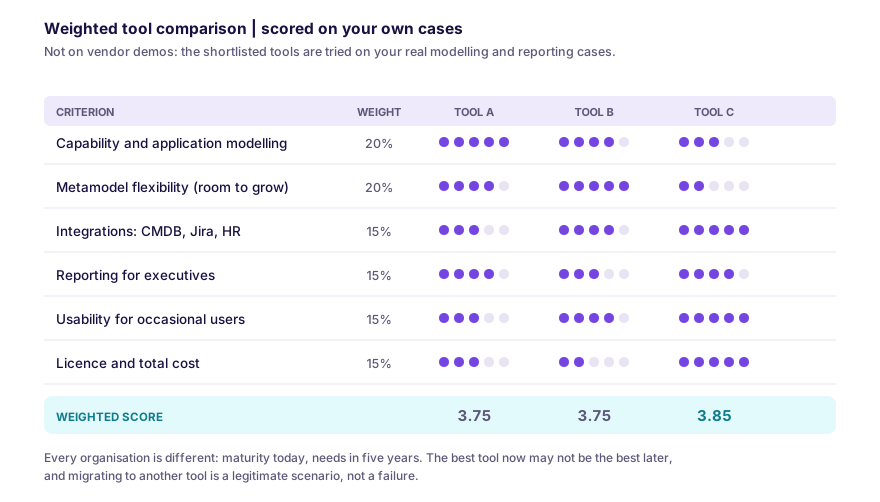
An example of a weighted tool comparison
An illustration. The criteria and the weights differ by company: every organisation is at a different level of maturity, and needs something different today from what it will need in five years. That is also why migrating from a well-chosen tool to another one later is not a failure.
When do you need us?

The expensive EA tool sits unused
The licence has been running for years, but the repository is empty or outdated. No one fills it, because it is no one's job.

Diagram chaos in drawing tools
Every team draws somewhere else, in its own way. Three diagrams exist for the same system, and none of them is current.

The rollout stalled halfway
The tool is there, the enthusiasm is gone. There was no metamodel to say what to record and how, and no one was responsible for the content.
Our process
Needs assessment
We clarify what the tool is really for: who will use it, which questions it must answer, and what a spreadsheet can no longer do. This becomes the requirements list.
Vendor-independent selection
We weight the requirements and narrow the field on that basis, typically to three candidates. We do not compare the shortlist on vendor demos but on your real cases: your own capability map, applications, and reporting needs. The decision is supported by a weighted, fact-based comparison.
Metamodel and data load
We fit the metamodel to the maturity and needs of the organisation, in a way that stays extensible later: we do not record what is theoretically possible, but what the organisation can genuinely keep up to date today. We load the initial content, the capability map and the application and process inventories, so the tool answers questions from day one.
Operating routine and owner
We name the owner of the content and embed the update rules into daily operations: who records what, and when. A tool stays alive because maintaining it is someone's job.
Let's see what this would give you.
Book a free 30-minute consultationThe market you are choosing from
The tools below are present on the enterprise architecture market today; this is the field we know and follow. We deliberately add no descriptions or rankings: in a selection we do not look for justification for a tool picked in advance, we start from your weighted requirements.
- ABACUSAvolution · Australia
- ADOITBOC Group · Austria
- ArdoqArdoq · Norway
- Bee360Bee360 · Germany
- BIC PlatformGBTEC · Germany
- Bizzdesign AlfabetBizzdesign · Netherlands
- Bizzdesign HopexBizzdesign · Netherlands
- Bizzdesign HorizzonBizzdesign · Netherlands
- Bizzdesign UnifyBizzdesign · Netherlands
- BlueDolphinBlueDolphin · Netherlands
- BoldoBoldo · France
- CATIA Magic Systems of Systems ArchitectDassault Systèmes · France
- Dragon1Dragon1 · Netherlands
- Enterprise ArchitectSparx Systems · Australia
- Enterprise ArchitectureServiceNow · USA
- Enterprise InsightEnterprise Insight · USA
- erwin EvolveQuest Software · USA
- EssentialEnterprise Architecture Solutions · United Kingdom
- IQ PlatformInQuisient · USA
- MavimMavim · Netherlands
- NH360 Enterprise ConnectNorth Highland · USA
- OrbusInfinityOrbus Software · United Kingdom
- ProlaborateSparx Systems · Australia
- QPR EnterpriseArchitectQPR Software · Finland
- QualiWare XQualiWare · Denmark
- SAMUAtoll Technologies · Hungary
- SAP LeanIXSAP · Germany
- smart360OnePlan Solutions · USA
- System ArchitectUNICOM Systems · USA
- YouDesignins-pi · Germany
What you get
- Requirements list derived from real user needs
- Fact-based tool comparison with candidates tried on your real cases
- Metamodel defining the elements, relationships and depth to record
- Loaded initial content: capability map, application and process inventories
- Operating routine with a named content owner and update rules
What it gives you
- A loaded tool that answers questions from day one
- Up-to-date architecture knowledge living in one place, instead of scattered diagrams and slide decks
- Content maintained for the long run: updating is a named owner's job
- A tool used as a working instrument, not an unused licence cost
Frequently asked questions
What if we switch to another tool later?
That is not a failure but a realistic scenario. Every organisation is at a different level of maturity, and needs something different today from what it will need in five years. That is exactly why we shape the metamodel and the content so that they are not tightly bound to one tool: the knowledge survives a later migration.
Selection and adoption: do we have to ask for both?
No. We support each separately too. Some clients want independent help only with the decision, because their own team will handle the adoption; others have already bought the tool and it simply does not work, and there we start with the adoption.
Which vendor's tool do you recommend?
None in advance. Selection starts from your needs: we set weighted requirements and compare the candidates along them, on your own real cases. We do not look for justification for a tool picked in advance.
We already have a tool, but no one uses it. Can you still help?
Yes, this is a common starting point. In that case we do not look for a new tool; we add the missing pieces: metamodel, initial data load, an owner and an operating routine. If the tool turns out to be genuinely unfit for your purposes, we say so.
Is it not enough to buy a good tool?
No. The tool solves nothing by itself: with an empty repository it is only a licence cost. It comes alive when there is a metamodel, an owner and governance behind it, which is why adoption centres on these three.
How does this relate to your EA governance service?
Closely. Governance states who must update the architecture content and when; the tool is the instrument for that work. If you do not have such rules yet, our EA governance service provides the framework.
Who maintains the loaded content in the long run?
Ideally an internal owner. If you lack the capacity for it, we carry the maintenance of the loaded map forward within EA as a service: we update the content in a regular rhythm, so the tool stays current.
How we can work together

Fix Scope
Scope and fee are agreed together at the start. For well-defined work this is the most predictable form; the business capability map, for example, typically runs this way.

Time & Material
Effort-based billing with a flexible scope. It works best when the task takes shape along the way and quick changes of direction matter.

Architect as a Service
An ongoing arrangement: architect capacity without hiring a full-time specialist. It can be fixed-price and predictable, or ad-hoc involvement; it scales up or down as needs change.
Book a free 30-minute consultation
Tell us briefly about your situation. We'll get back to you and start with a free, no-obligation 30-minute consultation.