Business architecture target operating model
- 4 steps from current state to rollout sequence
- maturity and priority the basis of the rollout order
In many organisations, business architecture is the individual effort of talented people: material gets produced, but the work restarts with every project, and decision-makers do not know when or why to turn to it. That is not a competence gap; it is an operating model gap.
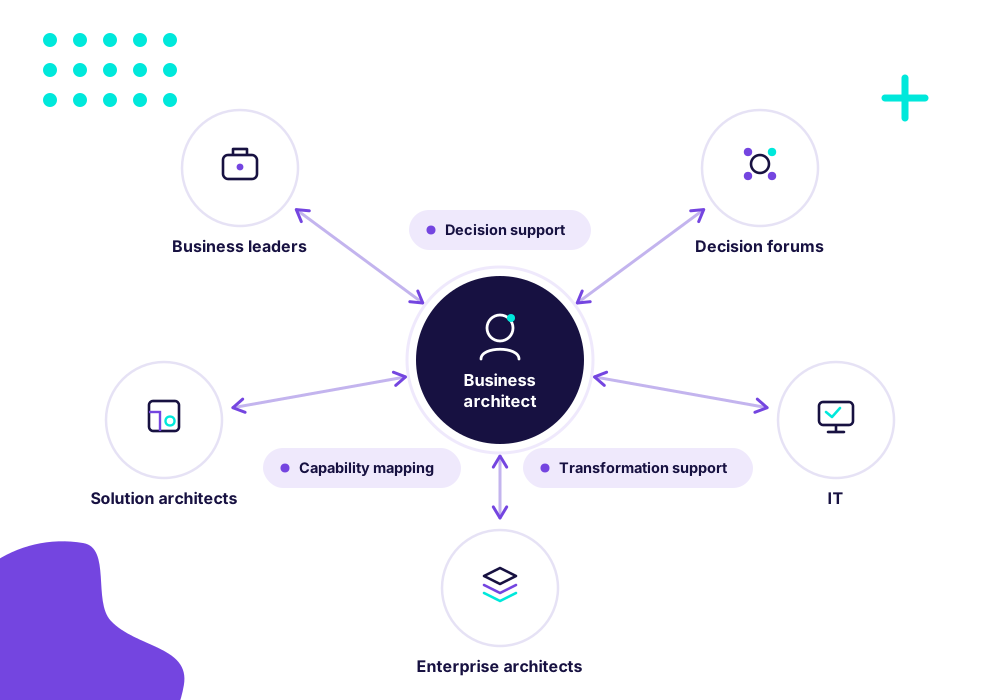
We design the function itself, and the first half of that is the concrete work: we go through what activities the business architects’ day-to-day work consists of, from capability map stewardship through decision support to supporting transformations, and we assign each a purpose, a deliverable, and an owner. The second half is the connections: business architects usually connect well to their own business area, and the model sorts out how they connect to the rest of the company. We give them a seat at the business decision forums, at strategy and portfolio decisions, and we set the frame for working with business leaders, with IT, and with the other architecture disciplines, mainly enterprise architects and solution architects. We sequence the rollout by maturity and priority, so the function delivers visible value within the first months.
When do you need us?

Architecture work restarts with every project
Every initiative starts almost from scratch: what was assessed once gets assessed again. The results of earlier work get lost instead of building into a system.

No one knows when to involve it
The business architect role exists, but it is not stated which decisions it should be involved in, or what it contributes to the organisation.

There is no bridge between strategy and delivery
The business goals set the direction, yet projects get started independently of them: it is not visible which development moves which goal forward, or which capability it strengthens.
Our process
Current state
We capture how and where architecture-type work happens today: who does it, for whom, and with what result.
Activity catalogue and value proposition
We define the activities of business architecture: each with its purpose, deliverable, stakeholders, and value proposition.
Roles, forums, connections
We clarify the roles and decision forums: the business architect gets a seat at strategy and portfolio decisions, and we set the frame for collaboration with business leaders, IT, and the enterprise and solution architects.
Rollout sequence
We order the activities by maturity and priority: we start with what delivers value fastest.
Let's see what this would give you.
Book a free 30-minute consultationWhat you get
- An activity catalogue: the tasks of business architecture with purpose, deliverable, and stakeholders
- Clarified roles and decision forums: the business architect's seat at strategy and portfolio decisions
- A defined collaboration frame with business leaders, IT, and fellow architecture disciplines (enterprise and solution architects)
- An operating rhythm: when what gets produced, and who it goes in front of
- A rollout sequence ordered by maturity and priority
What it gives you
- Architecture work that adds up to a system instead of restarting with every project
- A role made clear: it is visible which decisions the business architect is involved in, and what the role provides
- An institutional link between strategy and delivery: portfolio decisions built on capabilities
- A function that delivers visible value within the first months
What it looks like in practice
An operating model for the business architects
The challenge
The business architects connected well to their own business areas, yet their role had no boundaries: everything was expected of them, from portfolio-level work down to concrete business analysis tasks. What got squeezed out was exactly the essence of the role: the higher-level, comprehensive planning. Their connection to the enterprise architecture area was not clear or balanced either.
What we did
Working with the managers, we agreed on where each role sits. We clarified how the business architects connect to the business analysts, and settled the relationship with the enterprise architecture area. The new operating model set out which activity belonged to whom, in which forums, and at what cadence.
What came out of it
- A clarified division of roles between business architects, business analysts, and enterprise architects
- The business architects' time freed up for comprehensive, higher-level planning
- The connections settled at the level of policies as well
- The area's operation became predictable
Frequently asked questions
Do we need an existing architecture team?
No. For a starting function, the model says what to begin with and in what order. For an existing team, it shows where value leaks away and what to change.
How does it relate to the maturity assessment?
The Business architecture maturity assessment tells you where you stand; the operating model tells you how to operate. The two often come in sequence: first the mirror, then the plan.
As part of an international group we must align with the group model. Is that covered?
Yes, adaptation is part of the craft: what can be adopted from the group-level model, we adopt; what reflects local regulation, legacy, and needs, we design locally.
Do you also help operate it?
Yes: within Business architecture as a service we can run the designed operation until the internal team is ready to take it over.
How we can work together

Fix Scope
Scope and fee are agreed together at the start. For well-defined work this is the most predictable form; the business capability map, for example, typically runs this way.

Time & Material
Effort-based billing with a flexible scope. It works best when the task takes shape along the way and quick changes of direction matter.

Architect as a Service
An ongoing arrangement: architect capacity without hiring a full-time specialist. It can be fixed-price and predictable, or ad-hoc involvement; it scales up or down as needs change.
Book a free 30-minute consultation
Tell us briefly about your situation. We'll get back to you and start with a free, no-obligation 30-minute consultation.