Business architecture maturity assessment
- 5 levels from initial to measured
- 8 dimensions from mandate to business use
- 2–4 weeks typical duration
Most organisations already have some architecture work: a map was made, an assessment was run, a rule or two exists. The question is not whether it exists, but whether decisions are actually built on it. The gap between the two is enormous, and hard to judge from the inside.
Our maturity assessment holds up a mirror. The five levels follow the ACMM maturity model also referenced by the TOGAF® standard, from initial to measured; the eight assessment dimensions are built from our own practice. We show where the organisation stands today and what target level is realistic: the maturity levels depend on one another, so the target is set together with the enterprise, business, and IT maturity, measured against what is feasible. We do not hand out a theoretical grade; we provide a development path.
The eight dimensions range from mandate and strategy linkage through content, method, governance, organisation, and tooling to actual business use. The exact assessment criteria may differ from company to company: we always tailor them to the company’s focus and needs. Ultimately the assessment shows how deeply architecture is embedded in the decision processes. Where that embedding is missing, building business architecture governance is the natural next step.
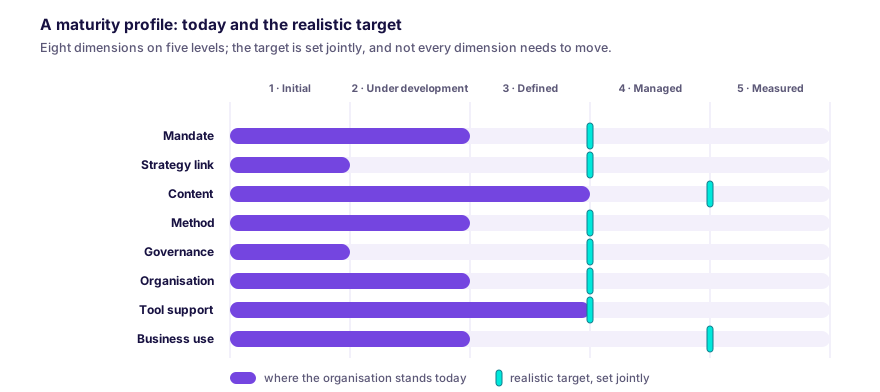
An example maturity profile
For each dimension you see today's level and the realistic target set jointly; not every dimension needs to move. In a real assessment the dimensions follow the company's focus and needs.
When do you need us?

There is a map, but it is not used
Architecture material exists, but decisions are not built on it. The document lives on; the practice does not.

No one knows where they stand
There is no benchmark for what good architecture practice looks like, or how much is missing.

The direction of the next step is disputed
Buy a tool, hire a person, fix a process? Without a maturity picture, the way forward is a matter of opinion.
Our process
Current state
Interviews and document review: how architecture decisions are made today, what exists, and what is missing.
Maturity evaluation
We evaluate along the five levels (from initial to measured) and eight dimensions, from mandate to actual business use.
Target level and path
We set a realistic target level: the maturity levels depend on one another, so the target is set together with the enterprise, business, and IT maturity, measured against what is feasible, and the way there is broken into steps.
Reassessment
We leave a reassessment framework with you: we reassess at an agreed rhythm, or your team reassesses on its own using the framework.
Let's see what this would give you.
Book a free 30-minute consultationWhat you get
- A maturity picture for every dimension of the model: where the organisation stands today
- A realistic target-level recommendation with rationale, weighed against the enterprise, business, and IT maturity: what is worth reaching, and what is not
- A step-by-step development path from the current level to the target
- A reassessment framework that stays with you: we reassess at an agreed rhythm, or your team reassesses on its own using the framework
What it gives you
- A benchmark: it is visible where the organisation stands today, and how much is missing for good architecture practice
- A clear view of whether decisions are actually built on the architecture, not merely whether models exist
- A fact-based direction for the next step, instead of opinions
- Progress that can be tracked at an agreed rhythm: what has moved, and where it is stuck
Frequently asked questions
Do you use a well-known industry maturity model?
Our levels follow the ACMM maturity model also referenced by the TOGAF® standard: initial, under development, defined, managed, measured. The eight assessment dimensions, however, we built from our own consulting practice, tuned to what we actually see at organisations in the region: we do not measure theoretical completeness, but whether decisions are really built on the architecture.
Who do you interview?
The business architects and their leaders, the head of EA, the leaders of the business areas, and the CIO/CTO. Beyond that, the owners of strategic planning and the portfolio, because one of the most important tests of maturity is whether the architecture actually influences their decisions, and the consumers of the architecture: programme and project leads and solution architects.
Do we need a finished capability map first?
No. The assessment shows exactly how much decision quality is lost when the map is missing or outdated. If it turns out one is needed, our Business capability map service is the natural next step.
What happens after the assessment?
The development path can be carried by our Business architecture governance and Business architecture as a service offerings; in smaller organisations the internal team often carries it, and we reassess at an agreed rhythm.
What size of organisation is it for?
It gives the most where several developments or transformations run in parallel, and leadership senses that the architecture work does not add up to a system.
How long does it take?
Typically 2 to 4 weeks: it builds on executive and key-person interviews and a review of existing material. We are not starting a project; we are holding up a mirror.
How we can work together

Fix Scope
Scope and fee are agreed together at the start. For well-defined work this is the most predictable form; the business capability map, for example, typically runs this way.

Time & Material
Effort-based billing with a flexible scope. It works best when the task takes shape along the way and quick changes of direction matter.

Architect as a Service
An ongoing arrangement: architect capacity without hiring a full-time specialist. It can be fixed-price and predictable, or ad-hoc involvement; it scales up or down as needs change.
Book a free 30-minute consultation
Tell us briefly about your situation. We'll get back to you and start with a free, no-obligation 30-minute consultation.