
AI workshop: where does AI actually help?
- 4 or 8 hours half-day or full-day format
- use cases ranked by their real value
- 6–12 people ideal group size
There is a lot of noise around AI, and it is hard to separate what brings real value from what is just fashion. A half-day or full-day workshop helps give a realistic, shared picture.
Together we go through where AI can actually help in your processes, how much is at stake in each idea, and what responsible, regulation-compliant use requires. By the end of the day we mark the few use cases worth starting with, and clarify what to watch for.
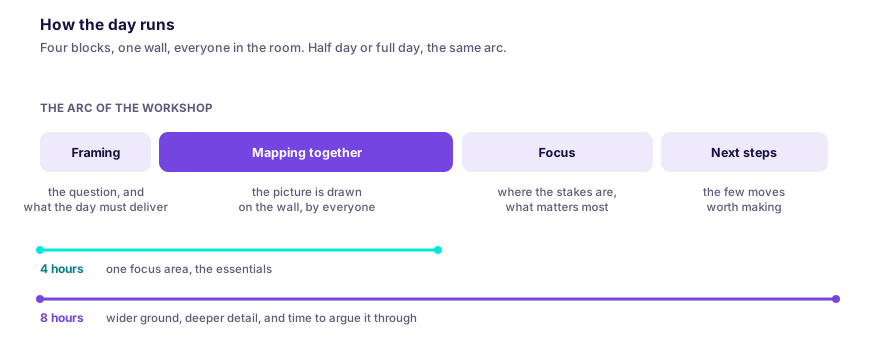
How the day runs
The backbone of the day is the map of opportunities: where AI genuinely helps, and where it is not worth it. The four-hour format focuses on one area; the eight-hour one also works through the questions of responsible use in detail.
When do you need us?

Everyone wants AI, but there is no direction
There are plenty of ideas, but it is not clear which brings real value and which is just fashion.

The questions of responsible use are unclear
It is not clear what the regulation allows, and what to watch for with the data.

You need a common starting point, fast
Leadership wants to decide, but a shared, realistic picture of AI is missing.
Our process
Warm-up
We clarify what the organisation expects from AI, and the goal of the day.
Map of opportunities
We go through where AI can actually help in your processes, and where it is not worth it.
Stakes and responsibility
We go through how much is at stake in each idea, and what responsible, regulation-compliant use requires.
Next steps
We mark the few use cases worth starting with.
Let's see what this would give you.
Book a free 30-minute consultationWhat you get
- A jointly drawn map of the AI opportunities, ranked by their real value
- The key aspects of responsible use, in light of the EU AI Act
- A short summary within a few working days, with the most promising use cases
What it gives you
- A shared, realistic picture of AI, with fashion and reality separated
- A clear priority: where to start, and what to leave out
- Awareness of responsible, regulation-compliant use
Frequently asked questions
Is this a technical workshop?
No. The focus is on business value and responsible use, not on the technology.
Do we need prior AI knowledge?
No. The whole point is to give a shared, realistic picture, regardless of prior knowledge.
What happens afterwards?
If you want to organize the ideas into a portfolio, the AI use-case portfolio is the continuation; if you need the frameworks, AI governance.
How many people should take part, and who?
It works best with six to twelve people. Representatives of the business areas, IT, and the colleagues responsible for data should sit at the same table. No prior AI knowledge is needed: the point is precisely to arrive at a shared, realistic picture.
What do we get after the workshop?
We send the map of ideas and the most promising use cases in an organised form within a few working days, together with the key considerations of responsible use.
How we can work together

Fix Scope
Scope and fee are agreed together at the start. For well-defined work this is the most predictable form; the business capability map, for example, typically runs this way.

Time & Material
Effort-based billing with a flexible scope. It works best when the task takes shape along the way and quick changes of direction matter.

Architect as a Service
An ongoing arrangement: architect capacity without hiring a full-time specialist. It can be fixed-price and predictable, or ad-hoc involvement; it scales up or down as needs change.
Book a free 30-minute consultation
Tell us briefly about your situation. We'll get back to you and start with a free, no-obligation 30-minute consultation.