
AI use-case portfolio and readiness
- 4–6 weeks typical duration
- 3–5 pilot candidates typically from 20–40 discovered opportunities
- EU AI Act compliance framework
- not a prerequisite data warehouse or platform
Where does AI pay off, not in general, but in your company? We project the AI opportunities onto your capability map and rank them by business value and feasibility, assess your data and organisational readiness, and provide a governance framework to go with it, aligned with the requirements of the EU AI Act.
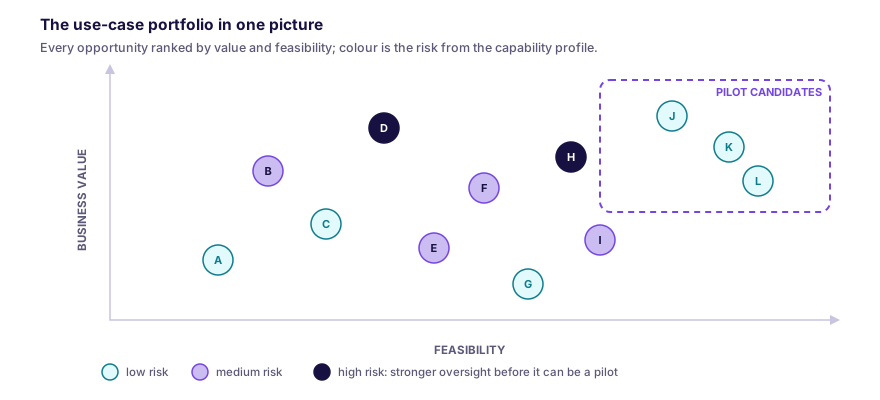
An example AI use-case ranking
Every discovered opportunity lands in the space of business value and feasibility, with colour showing the risk from the capability profile (6C). Pilot candidates come from the top right, at low risk.
When do you need us?

Everyone's doing AI, but who understands it?
There's pressure from the top, and no shortage of apparent expertise; but no one to tell you, on a factual basis, what AI is good for in your situation, and what it isn't.

The pilots never reach production
After enthusiastic experiments, projects get stuck on data, integration, compliance, or accountability questions.

Many don't know the letter of the AI Act
You use AI (or you're about to), but there's no regulatory map: what's prohibited, what's high-risk, what has to be documented.
Our process
Opportunity discovery
Projected onto the capability map and the application portfolio, we search with three lenses: where a capability is not covered, or only weakly; where today's solution fits the current architecture poorly; and where a major performance gain is achievable, typically in high-volume, repetitive work.
Prioritisation
We rank by business value, feasibility, and risk: typically 3 to 5 pilot candidates remain from 20 to 40 discovered opportunities. The returns decide, not the hype, and a good candidate is one where the data is already available.
Readiness assessment
Data, integration, skills, and process: what it takes for the selected use case to work in production.
Governance and roadmap
We deliver rules, responsibilities, and an AI Act compliance framework, plus a pilot plan for the first step.
Let's see what this would give you.
Book a free 30-minute consultationWhat you get
- AI opportunity list projected onto the capability map, ranked by business value, feasibility, and risk
- Readiness assessment of what it takes to run in production: data, integration, skills, process
- Governance rules and responsibilities with an EU AI Act compliance framework
- Pilot plan for the first step
- Support in selecting the implementation partner
What it gives you
- A fact-based picture of what AI is good for in your situation, and what it isn't
- AI decisions driven by returns instead of hype
- A clear view of what production use requires: what's missing, and what isn't
- AI initiatives launched in line with the requirements of the EU AI Act
- The cost of a failed AI project saved, if no use case turns out to be worth it
Frequently asked questions
Does this connect to the Application portfolio assessment?
Yes. A large share of AI opportunities sit where existing applications can be replaced or augmented. If an Application portfolio assessment has been done, we build on it; together the two give the full picture.
Do you also build AI solutions?
No: we provide the decision and the framework; but we do help you select the implementation partner.
What does the EU AI Act mean for us?
Risk classification, documentation, and transparency obligations. Part of the assessment is translating that into your specific use of AI.
Do we need a data warehouse or a data platform first?
Not a prerequisite: the readiness assessment is exactly what shows what's missing and what isn't.
How long does it take?
The portfolio and the readiness typically take 4 to 6 weeks; the governance framework depends on the size of the organisation.
How is this different from your AI governance service?
This service tells you where AI is worth applying and what that takes; the AI governance service tells you the framework it should all happen within. The two also meet: we profile the risk of the use cases along the ITIL® AI capability model (6C), the same logic our AI governance service builds on. The natural order: portfolio and readiness first, governance before scaling.
What if no use case turns out to be worth it?
Then that's what we'll tell you, and that's a result, too: you've saved yourself the cost of a failed AI project.
How we can work together

Fix Scope
Scope and fee are agreed together at the start. For well-defined work this is the most predictable form; the business capability map, for example, typically runs this way.

Time & Material
Effort-based billing with a flexible scope. It works best when the task takes shape along the way and quick changes of direction matter.

Architect as a Service
An ongoing arrangement: architect capacity without hiring a full-time specialist. It can be fixed-price and predictable, or ad-hoc involvement; it scales up or down as needs change.
Book a free 30-minute consultation
Tell us briefly about your situation. We'll get back to you and start with a free, no-obligation 30-minute consultation.